About Thrive Philly

Bridging Gaps & Building Futures

Six years, one storefront on Cecil B. Moore, and a growing movement of Philadelphia girls and women.

The newsletter Caffeine & Capital Money, power, and how women who were never handed the map get through the building anyway. Subscribe on Substack Subscribe on LinkedIn
Our mission

What We Do

Thrive Philly empowers Black and Brown girls through prevention and diversion programs that center education, wellness, leadership, and activism. We create protective pathways away from justice involvement and toward thriving futures.

Our programs are built with and for the people we serve, combining the lived experiences of community members with the expertise of system leaders from Philly to create real, lasting change.

Our vision

A Philadelphia where every individual, regardless of background or income, has equitable access to opportunity, stability, and success. A city where communities are not only supported in moments of crisis, but continually empowered to lead, grow, and thrive for generations to come.

What we hold to

Our Core Values

A holistic framework for the persistence, matriculation, and sustainable success of women and girls.

Every value points here Persistence, Matriculation, and Sustainable Success
PSYCH SAFETY WELLNESS EQUITY CAPITAL VALIDATION

Open a value to swing its needle north. Five directions, one destination.

Real learning happens when students feel emotionally safe, seen, and valued. We design environments that affirm identity, cultivate belonging, and promote healing, because safety fuels curiosity and courage.

Evidence base

Edmondson, A. C. (1999). “Psychological Safety and Learning Behavior in Work Teams.” Administrative Science Quarterly, 44(2), 350–383.

Across 51 teams, Edmondson found that people only ask questions, admit mistakes, and try new things when they believe they will not be punished or humiliated for it. Psychological safety was the strongest predictor of learning behavior, and learning behavior predicted performance.

Read the study →

Wellness isn't an add-on. It's embedded into academics, leadership, and life-readiness, from movement and breathwork to mental health practices, so students can show up fully and sustainably.

Evidence base

Durlak, J. A., Weissberg, R. P., Dymnicki, A. B., Taylor, R. D., & Schellinger, K. B. (2011). “The Impact of Enhancing Students’ Social and Emotional Learning: A Meta-Analysis of School-Based Universal Interventions.” Child Development, 82(1), 405–432.

A meta-analysis of 213 programs and 270,000 students found that when social and emotional learning is built into the school day rather than added on the side, students gain an average of 11 percentile points in academic achievement, alongside better behavior and lower distress.

Read the study →

We build with and for low-income Black and Brown girls. We don't retrofit equity. We engineer it from the start through culturally responsive curriculum, trauma-informed practices, and community-rooted leadership.

Evidence base

Ladson-Billings, G. (1995). “Toward a Theory of Culturally Relevant Pedagogy.” American Educational Research Journal, 32(3), 465–491.

Ladson-Billings studied teachers who were consistently successful with Black students and found the difference was designed, not accidental: high expectations, curriculum rooted in students’ culture, and an explicit critique of the systems around them.

Read the study →

We equip students with knowledge, confidence, and strategies to navigate systems that weren't built for them, without compromising who they are or who they are becoming. We teach the map and travel it together.

Evidence base

Yosso, T. J. (2005). “Whose Culture Has Capital? A Critical Race Theory Discussion of Community Cultural Wealth.” Race Ethnicity and Education, 8(1), 69–91.

Yosso names navigational capital — the skill of moving through institutions never built for you — as one of six forms of wealth communities of color already carry. The job of a program is to strengthen and teach it, not to supply what is “missing.”

Read the study →

We uplift the lived experiences of every girl we serve. By embedding validation theory in our pedagogy, we reinforce each student's value, voice, and potential, and make it clear: you belong here.

Evidence base

Rendón, L. I. (1994). “Validating Culturally Diverse Students: Toward a New Model of Learning and Student Development.” Innovative Higher Education, 19(1), 33–51.

Rendón found that first-generation and low-income students rarely thrive on their own initiative alone. The turning point came when someone in authority actively affirmed them as capable learners — validation, offered early and often, changed who persisted.

Read the study →
About the Founder

Alliyah “Lee” Francis

J.D., M.S.Ed., PMP · Founder & Executive Director, Thrive Philly

Alliyah founded Thrive Philly in 2020 and built it from an idea into a multi-program organization with paid staff, three program lines, a physical community hub on Cecil B. Moore, and 26+ cross-sector partners. She owns the budget, the fundraising strategy, and the outcomes we report to funders and our board — and she still teaches in the room.

Outside of Thrive, she has spent a decade advising executives where data, money, and program strategy meet. Most recently she led a $10M portfolio of four national initiatives at Motivate Lab, building the business plans, forecasts, and financial models behind go/no-go decisions and sustaining $2.5M+ in annual revenue. She has designed and facilitated 52+ focus groups across 20 states, helped lead the largest student well-being survey in medical education history, and presented findings at the NIH, IAMSE, and AACOM.

Before all of that she taught high school biology in Philadelphia with Teach For America and evaluated behavioral health programs for SAMHSA-funded work at COMHAR. That’s the throughline: classrooms, clinics, boardrooms — and now a career café where girls and women get the map and the room to use it.
Caffeine & Capital — the newsletter from Thrive Philly. Money, power, and how women who were never handed the map get through the building anyway.
Founder Notes · From the newsletter

Caffeine & Capital

Money, power, and how women who were never handed the map get through the building anyway. Long-form on building, power, and rewriting shame into strategy. These are the essays behind the work at Thrive Philly: the receipts, the throughlines, and the practice it takes to hold your peach in your own life. New pieces land when there's something worth saying.

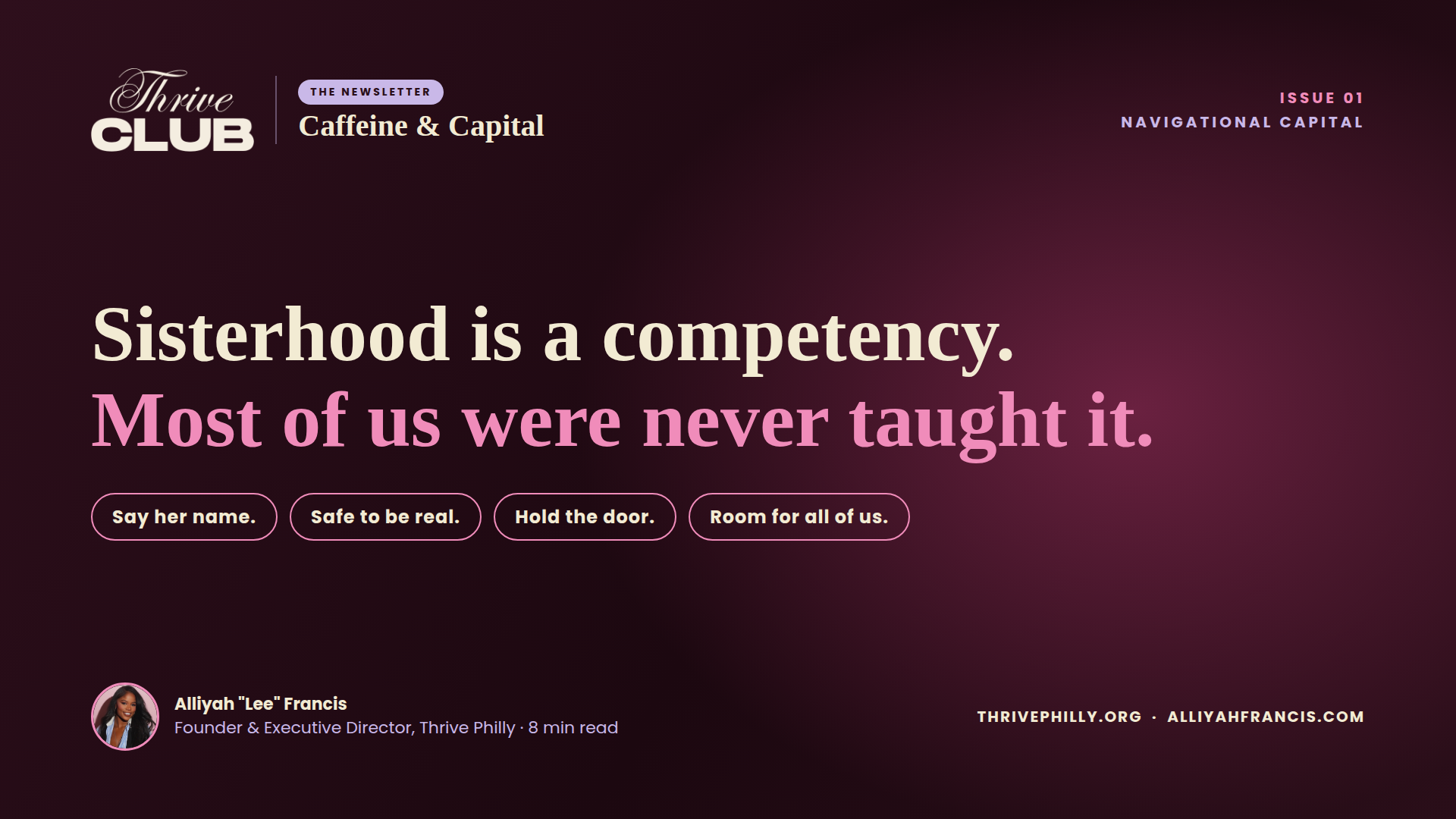
Caffeine & Capital, Issue 01 — Navigational Capital. Sisterhood is a competency. Most of us were never taught it. By Alliyah "Lee" Francis, 8 min read.
Issue 01 · Featured

Sisterhood is a competency. Most of us were never taught it.

Four behaviors the research says separate women who say "I got you" from women who actually do. And a question at the end of each one that you will not want to answer honestly.

8 min read · Alliyah "Lee" Francis

Read Issue 01 Subscribe on LinkedIn
01
Founder Notes

We Always Knew the Way: Wayfinding, Navigational Capital, and the Maps Black Folk Carry in Our Bones

Before GPS, before highways, before anyone drew a line on a map for us, we knew the way. An essay on navigational capital, the inherited knowledge Black folk use to move through systems that were never built for us, and the quiet genius of finding home anyway.

7 min read

02
Founder Notes New

How to Champion Your Testimony to Thrive as a Founder of Self

Every founder carries a testimony. Most are taught to hide it. This is the argument for doing the opposite, and the practice it takes to turn shame into strategy and conditions into receipts. Conditions are temporary. Identities are eternal.

Rewrite the shame. Hold your peach. Clock it.

Caffeine & Capital Money, power, and how women who were never handed the map get through the building anyway. Subscribe on Substack Subscribe on LinkedIn
Give

Fuel the Work. Fund the Future.

Your gift expands access to education, wellness, and mentorship for girls and women across Philadelphia.